
Flying Snakes Are Real — And They Glide with Precision
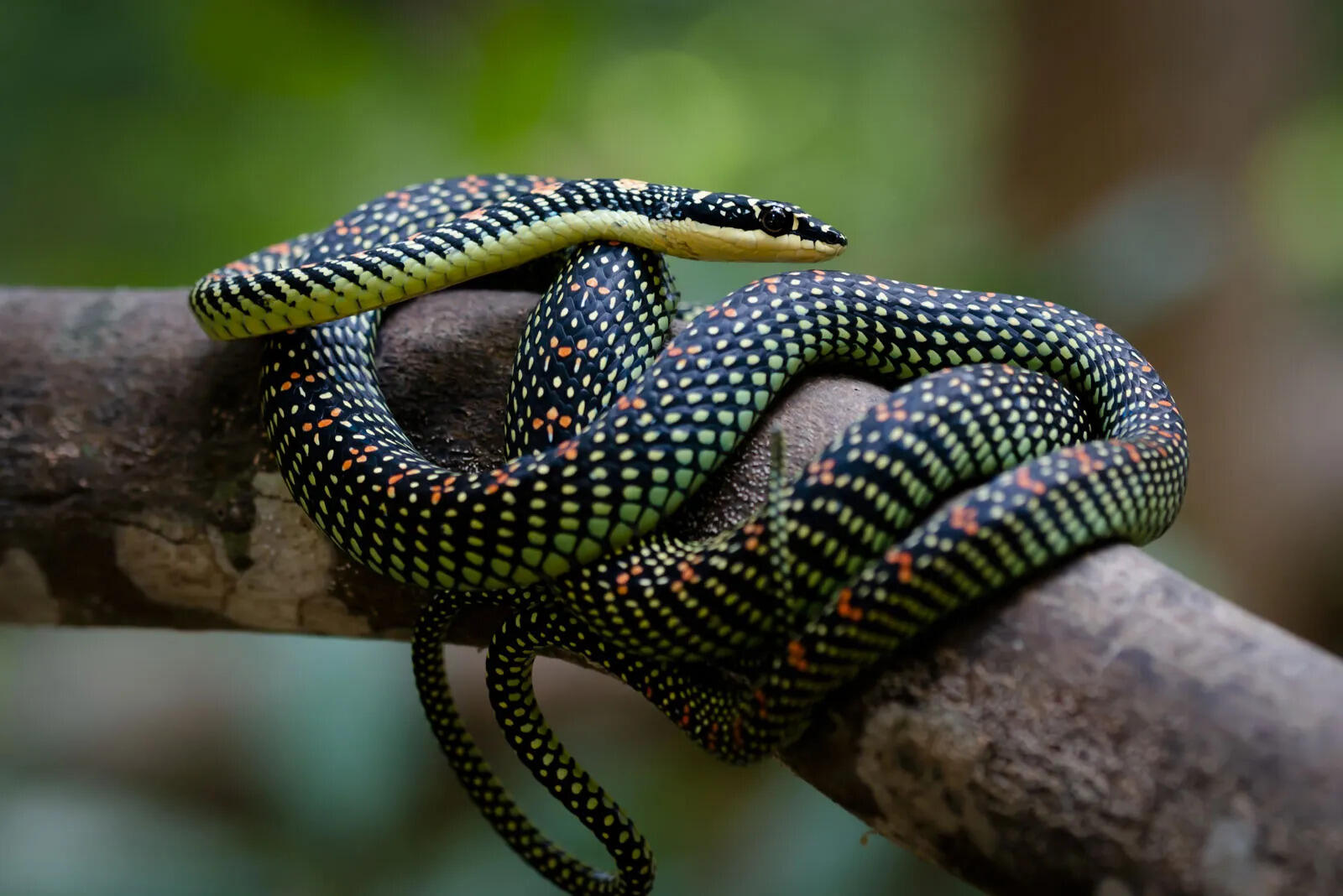
When most people think of snakes, they imagine creatures slithering through grass, coiled in trees, or camouflaged on the forest floor. But what if a snake could glide through the air, weaving between trees like a ribbon on the wind? It might sound like a scene from a fantasy novel, but such a creature exists — and it’s called the flying snake.
These real-life aerial acrobats belong to the genus Chrysopelea, and they are among the most fascinating and misunderstood reptiles in the animal kingdom. Native to Southeast Asia, these snakes have evolved a unique way to move between treetops — not by crawling, but by launching themselves into the air and gliding for distances of over 30 meters.
Let’s dive deep into the biology, behavior, and incredible adaptations of the flying snake, and understand how a legless reptile became one of the most graceful gliders in the natural world.
🐍 What Is a Flying Snake?
Flying snakes are not mythical creatures or the product of ancient legends. They are very real, very agile, and very efficient at what they do. Members of the Chrysopelea genus, these snakes are mildly venomous colubrids that include several species such as:
-
Chrysopelea ornata – the ornate flying snake
-
Chrysopelea paradisi – the paradise tree snake
-
Chrysopelea pelias – the twin-barred tree snake
Despite being called "flying" snakes, they don't actually fly like birds or bats. Instead, they are gliders. They jump from trees, flatten their bodies, and control their descent with remarkable precision. Their gliding can cover distances from 10 to 30 meters (sometimes even more), making them one of the most effective gliders among terrestrial animals.
🌳 Where Do Flying Snakes Live?
Flying snakes are primarily found in:
-
India
-
Sri Lanka
-
Thailand
-
Malaysia
-
Indonesia
-
The Philippines
-
Southern China
They prefer tropical rainforests, where dense vegetation and tall trees provide the perfect environment for their aerial lifestyle. They are arboreal, meaning they spend most of their lives in trees, and their ability to glide makes it easier to move from one tree to another without descending to the ground, where they would be more vulnerable to predators.
🪂 How Do They “Fly”?
The gliding ability of flying snakes is one of the most impressive physical adaptations in the reptile world. Here's how they do it:
-
Launch: From a high tree branch, the snake hangs off the edge in a J-shaped posture, then uses its muscles to push off and launch into the air.
-
Flattening the Body: As it begins to fall, the snake flattens its ribs, turning its cylindrical body into a concave wing-like shape. This increases surface area and creates lift.
-
Undulating in Midair: The snake makes serpentine, side-to-side motions while gliding — similar to swimming. This movement stabilizes the glide and helps steer.
-
Controlling Landing: The snake can steer left or right, gain some lift, and control its descent so it lands safely on another branch or tree trunk.
Researchers have discovered that this unique motion actually improves aerodynamic stability, making their glides smoother than many gliding mammals.
🔍 What Do They Eat?
Flying snakes are carnivorous and feed on a variety of small animals, including:
-
Lizards
-
Frogs
-
Birds
-
Rodents
-
Other small snakes
Their hunting strategy combines stealth, speed, and their gliding ability. They are particularly agile in the trees, using their flexible bodies to reach prey hiding in branches or tree hollows.
Though mildly venomous, they are not dangerous to humans. Their venom is used to subdue small prey and is not potent enough to cause serious harm to people.
🤔 Are They Dangerous?
In short — no, not to humans.
Flying snakes are not aggressive, and their venom is considered harmless to humans. They are reclusive, and like most snakes, prefer to avoid contact with people.
In fact, they are often considered beneficial to the ecosystem, as they help control pest populations like rats and insects. If you ever encounter one (most likely in parts of Southeast Asia), admire it from a distance — but rest assured, you are not in danger.
🧠 What Makes Them So Special?
Besides their gliding talent, flying snakes are remarkable for several reasons:
-
Biomechanical Mastery: They defy our expectations of what a snake can do. Without wings, limbs, or parachutes, they have evolved to manipulate the laws of physics purely through muscle control and body shape.
-
Evolutionary Innovation: Flying snakes show us that nature can solve mobility challenges in surprising ways. While birds developed feathers, and bats wings, the flying snake reshaped its body — and mastered the sky.
-
Scientific Inspiration: Engineers and roboticists have studied flying snakes to understand aerodynamics and stability. Their movements are being modeled in robotics and drone designs, especially for navigating through tight spaces or forests.
🌱 Conservation and Threats
While flying snakes are not currently listed as endangered, their habitats are under constant threat from:
-
Deforestation
-
Urban expansion
-
Illegal wildlife trade
-
Climate change
Preserving tropical rainforests is crucial to ensuring the survival of these unique animals. As more forests are cleared for agriculture and development, flying snakes — along with countless other species — lose their homes and hunting grounds.
Conservation efforts in Southeast Asia now include biodiversity corridors, forest reserves, and public awareness campaigns to highlight the importance of these lesser-known creatures.
🧩 Fun Facts About Flying Snakes
-
Despite having no limbs, they are more efficient gliders than flying squirrels.
-
Their flattened body becomes almost twice as wide during a glide.
-
They can change direction mid-air, even doing S-shaped curves while descending.
-
They are active during the day (diurnal), which makes them more visible to observers and researchers.
-
The paradise tree snake (Chrysopelea paradisi) is often considered the most skilled glider among them.
✈️ When Nature Breaks Its Own Rules
Flying snakes challenge the way we think about evolution and animal behavior. They prove that movement doesn’t require legs, wings, or engines — just ingenuity, adaptability, and the will to leap.
In the vast tapestry of life, few animals are as surprising or elegant as the flying snake. While it might give some people chills, it's also a symbol of nature’s creative genius — a creature that flies without wings, hunts with precision, and glides with an elegance that rivals birds.
So the next time you're in a tropical forest and hear a rustle from the canopy above, look up — you just might meet the flying snake, soaring silently between the trees, on its way to a new adventure.