
From Melody to Meditation: Hariprasad Chaurasia’s Timeless Journey with the Flute
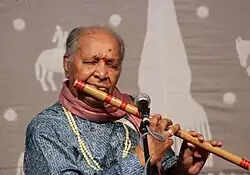
A Life Defined by Melody
Pandit Hariprasad Chaurasia is nearing his 87th year, yet his passion for music remains as bright as ever. Over six remarkable decades, he transformed the humble bamboo flute—India’s bansuri—into an instrument of worldwide reverence. With soulful notes and a unique teaching philosophy, Chaurasiaji has shared the essence of joy through music rather than mere instruction. His outlook: “I don’t play to teach, I play to spread happiness,” speaks volumes about his legacy.
From Village Beginnings to Global Recognition
Born in 1938 in Allahabad (now Prayagraj), Chaurasia’s first musical encounter was not with the flute, but with vocal music and dance. Drawn to melody, he learned classical Indian vocal traditions before discovering the bansuri. In a time when flute playing was limited to rural folk music, Chaurasia saw an opportunity to elevate it—and he pursued it relentlessly.
Mentored by training luminaries, including Annapurna Devi and Pandit Bholanath Prasanna, he absorbed both technique and deep emotional expression. By the early 1960s, he had mastered styles such as Kirana and Maihar gharanas and emerged as a path-breaking flute virtuoso.
A Paradigm Shift in Carnatic and Hindustani Music
Chaurasia reinvented the bansuri for classical concert halls. He extended its pitch range, refined breath control, and developed fingering techniques that allowed for gamakas (microtonal oscillations) and subtle ornaments usually associated with vocal music. Listeners began to hear the flute mimic a singer’s nuanced voice—a first in the art form.
His concerts made the bansuri more than a folk instrument—they became vehicles of meditative depth, capable of piercing introspection or celebratory mood. He became a sought-after performer for film scores as well, popularizing classical soundscapes in Indian cinema.
A Philosophy Rooted in Joy, Not Pedagogy
Chaurasia often emphasizes that his music is about sharing joy rather than teaching technique. He recalls early student interactions where he felt restricted by a narrow transmission-focused mindset. Instead, he pivoted to encourage listening, feeling, and improvising.
His message: music is a language to be experienced—not a set of rules to follow. He would play raga patterns slowly at first, urging students to savor each tone. Rather than correcting them harshly, he nudged them toward the emotion within. Through this approach, Chaurasia created an environment where creativity and joy became the true instruments of learning.
From Mentor to Global Ambassador
In the 1970s and ’80s, Chaurasia co-founded the Vrindavan Gurukul near Mumbai, an institution devoted to musical immersion. Here, students sleep, eat, and live with their guru, steeped in a rhythm of flute meditations, ragas at dawn, and evening recitals.
His teaching method is simple yet transformative:
-
Listen First: Before playing, students listen to mornings of raga elaboration.
-
Feel Each Note: Breathe with purpose; create microtonal shifts.
-
Play Slowly and Devotionally: Avoid haste. Artistry is born in emotion.
He has trained dozens of disciples—many becoming accomplished artists themselves—including Pandit Ronu Majumdar, Shri Nishat Khan’s son Sabir Khan, and international musicians like Wolfgang Guembel.
Key Milestones: Moments That Shaped His Journey
-
First Solo Concert in Mumbai (1960): A turning point that showcased the bansuri as capable of classical depth.
-
Collaboration with Ravi Shankar (1972): Brought him to international festivals like Woodstock and Lincoln Center.
-
Film Work in Bollywood: Iconic scores that featured his signature flute—emotionally expressive and culturally resonant.
-
Padma Vibhushan (1992) and Padma Bhushan (1972): Recognition of his contribution to classical and film music.
-
Global Workshops and Festivals: Presenting Indian music to new audiences across Europe, North America, and Asia.
Musical Style: Signature Elements of His Art
Chaurasia’s playing is instantly recognizable for its:
-
Bamboo-Clarity Tone: Pure, breathy, organic.
-
Subtle Microtones: Achieved through masterful embouchure control and fingering.
-
Slow-Build Phrasing: Exploration of alap that unfolds organically.
-
Immersive Emotion: Each raga becomes a serene conversation, not a display of technical prowess.
Whether it’s the melancholy of raga Darbari Kanada or the majesty of Yaman, Chaurasia weaves deep emotional resonance into every note, urging listeners to listen with their hearts.
Journeys Beyond Borders
Chaurasia’s workshops have taken him to Carnegie Hall, Royal Albert Hall, and the Berlin Philharmonie. There, he not only performed, but also introduced Indian classical notation, rhythmic structures, and improvisational ethos. Collaborations with jazz musicians and world music ensembles highlighted a shared musical truth: emotion transcends language. He taught that playing with intent is more powerful than demonstrating knowledge.
Film Scores That Defined Him
In Bollywood, Chaurasia’s flute captures emotional depth:
-
A flute solo under a rain-soaked Rohit scene
-
A lilting melody in a village setting
-
A haunting tone capturing longing and empathy
He gave directors an instant emotional palette. His film music—though brief—is instantly recognized and eternally loved.
Role of Technology and Legacy
Despite a simple instrument, Chaurasia embraced modern audio recording and digital teaching. His online masterclasses, archived recordings, and recorded concerts made his music accessible globally. Recently, he even used mobile apps to demonstrate improvisation in real time—proof that tradition and modernity can harmonize.
Personal Reflections: Life, Health, and Music
Now in his late eighties, Chaurasia credits his vitality to daily riyaaz (practice), walking in nature, and heartfelt connections with youth and music. He notes that music healed his loneliness and remains his greatest teacher. Every morning, he wakes with his bansuri—his partner in exploring the timeless beauty of ragas.
A Final Thought: Joy Defines His Legacy
When he says, “I don’t play to teach, I play to share joy,” it’s not modesty—it’s a declaration. His legacy transcends awards and disciples. He showed that classical Indian music is not elitist; it’s for every heart attuned to its rhythms. By remaining faithful to emotion and expression, not spectacle, Pandit Hariprasad Chaurasia leaves a lasting legacy of heartfelt musicianship and lifelong joy.
A Maestro’s Gift to the World
Pandit Hariprasad Chaurasia’s six-decade journey with the flute is a testament to the power of dedication, emotion, and genuine human connection. He has shaped the narrative of Indian classical music, bringing bansuri into the global limelight. More than a teacher, more than a performer, he is an embodiment of joy—an artist whose legacy is heard in every soulful note echoed by devices and hearts around the world.
Whether you're a seasoned listener or a newcomer, his music beckons: breathe with intention, listen with depth, embrace joy in every silken swell of bamboo, and let the flute speak where words cannot.